Arjun and Vikram are brothers living in Indore.
Before Diwali, both decide to start a small house-painting business. Every year, people repaint their homes before the festival, so the demand is predictable.
Arjun uses only his own savings.
He spends ₹20,000 on brushes, ladders, rollers, and paint trays. Over the next two months, he paints several houses and earns ₹10,000 in profit.
So Arjun’s business looks like this:
Money he invested: ₹20,000
Profit he earned: ₹10,000
Someone calculating his return would say Arjun earned 50% on his money.
Now look at Vikram.
Vikram also starts the same painting work. But he only has ₹10,000 saved. Instead of staying small, he borrows another ₹10,000 from a local lender to buy the same equipment as Arjun.
Total money used in the business: ₹20,000
His own money: ₹10,000
Borrowed money: ₹10,000
At the end of the season, Vikram also earns ₹10,000 in profit.
Now something interesting happens.
If you measure the return only on Vikram’s own money, the number looks extraordinary.
Profit: ₹10,000
Equity (his own money): ₹10,000
That’s 100% return.
Vikram appears to be the better businessman.
Twice as good as Arjun.
But the businesses were identical.
Same work.
Same earnings.
Same tools.
The only difference is that Vikram used borrowed money.
This is exactly the moment where two different metrics appear.

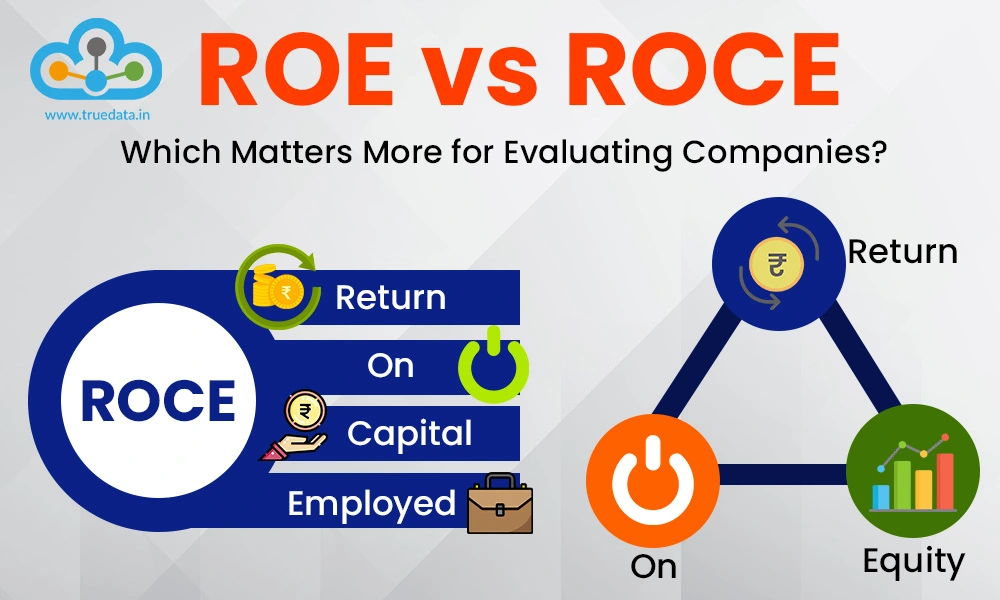
Return on Equity (ROE)
ROE measures how much profit a company generates compared to the money shareholders invested.
ROE Formula
ROE = Profit ÷ Equity
For Vikram:
₹10,000 ÷ ₹10,000 = 100% ROE
Return on Capital Employed (ROCE)
ROCE measures profit relative to all the money used in the business — both the owner's money and borrowed money.
ROCE Formula
ROCE = Profit ÷ Total Capital Used
For Vikram:
₹10,000 ÷ ₹20,000 = 50% ROCE
Suddenly, Vikram’s business looks exactly like Arjun’s.
Because economically, it is.
Quick Signals
Good sign:
ROE and ROCE both stay strong.
Warning sign:
ROE rises mainly because of increasing debt.
Why it matters:
Debt can inflate ROE without improving the real strength of the business.
Allocator Note:
When ROE is far higher than ROCE, leverage is usually doing the work. The gap between the two numbers often reveals how much of the return comes from business quality versus financial structure.
Where the Simple Version Breaks

Most beginner investing guides treat ROE as the gold standard.
A company with 20% ROE looks superior to one earning 12% ROE.
That comparison works only when both businesses use similar amounts of debt.
Once leverage enters the picture, ROE becomes easy to distort.


The Leverage Distortion
Imagine two companies generating identical operating profits.
Company A operates with almost no debt.
Company B finances half its assets through borrowing.
Because Company B has less shareholder equity on its balance sheet, the same profit gets divided by a smaller number.
The ROE jumps.
Nothing improved operationally.
Only the balance sheet changed.
When the Cycle Turns
During aggressive expansion phases, this distortion becomes common.
Many infrastructure companies between 2014 and 2019 increased leverage dramatically.
Their ROE initially improved because equity stayed constant while assets expanded through borrowing.
Then the cycle turned.
Earnings slowed
Debt remained fixed
ROE collapsed faster than it rose.
The ratio didn’t lie — it just told an incomplete story.
ROCE exists to reveal the part that ROE hides.
Operational Reality: How Investors Actually Use These Metrics

When I screen businesses, I rarely look at ROE alone.
The relationship between ROE and ROCE together tells a far richer story.

Pattern 1: Minimal Leverage
Start with the simplest pattern.
If a company shows:
ROE of 22%
ROCE of 21%
The gap is tiny.
That usually signals minimal leverage.
The business itself is generating strong returns without heavy borrowing.
Pattern 2: Leverage Amplifying Returns
Now look at a different structure.
Suppose a company reports:
ROE: 24%
ROCE: 13%
That gap is doing something important.
It means debt is amplifying returns to equity holders.
This isn’t automatically bad.
In capital-intensive industries — such as:
Cement
Telecom
Infrastructure
— Moderate leverage is part of the business model.
The Key Question
The key question becomes whether the ROCE comfortably exceeds the cost of capital.
If a company consistently earns:
18–20% ROCE
While borrowing at 8–10% interest
Leverage works in its favour.
Debt becomes a tool that increases shareholder returns.
When the Spread Shrinks
But watch what happens when that spread shrinks.
During the 2019–2020 slowdown cycle, several mid-cap industrial companies saw:
ROCE compress from 17–18%
Down to 10–11%
While debt remained unchanged.
ROE fell dramatically.
The leverage that once boosted returns suddenly magnified the decline.
Direction Matters More Than the Snapshot
That dynamic is why the direction of ROCE over time often matters more than the headline ROE.
A company with ROCE expanding from 11% to 16% over four years usually signals improving operational strength.
A company showing ROE rising while ROCE stagnates often indicates increasing leverage rather than improving economics.
A Practical Screening Pattern
When I evaluate a business, three numbers tend to appear together:
ROCE above 15% for at least five years
ROE is higher than ROCE, but not dramatically higher
Debt-to-equity below roughly 1.5×
That combination usually signals a business generating strong returns without leaning excessively on leverage.
It’s not a rule.
But over the last two decades of Indian market data, companies sustaining those conditions have tended to compound capital more reliably than those relying heavily on financial engineering.
The Honest Limit
ROCE improves the picture, but it still has edges.
Asset-Light Businesses

Asset-light businesses distort the denominator.
Examples include:
Software companies
Digital platforms
Marketplaces
These operate with very little capital employed.
The capital base stays small while profits scale rapidly.
ROCE can appear extremely high — sometimes 40–60% — even when the business faces intense competition.
In those cases, the ratio reflects accounting structure more than economic durability.
The Asset Age Problem
There’s another limitation.
ROCE is usually calculated using accounting assets purchased years earlier.
Inflation and depreciation can make those assets appear smaller than their real replacement cost.
Older manufacturing companies sometimes report 20%+ ROCE simply because their factories were built decades ago.
If those assets had to be rebuilt today, the returns might look very different.
That’s one area where I still rely heavily on judgment rather than formulas.
Forward Tension
Over the last three earnings cycles, I’ve noticed something interesting in several Indian consumer brands.
Their ROE remains above 25%, which looks exceptional on the surface.
Yet ROCE has gradually declined from around 21% to 16%.
The gap between the two numbers is widening.
That pattern can mean leverage or working-capital changes are quietly supporting returns.
I’m watching whether that spread continues expanding over the next few quarters.
If it does, the apparent profitability of that sector may be more fragile than the headline ROE suggests.
Author Mr Chandravanshi
Nishant Chandravanshi — Mr Chandravanshi writes about judgment, decision-making, investing, and systems thinking.
Platforms
Substack
Newsletter essays and published writing
https://digimanako.substack.com/
Medium
Long-form essays and analytical writing
https://medium.com/@digimanako
Medium Publication — Judgment Under Pressure
Publication on decision-making and systems thinking
https://medium.com/judgment-under-pressure
Medium Publication — The Honest Confusion
Articles explaining confusing school concepts
https://medium.com/the-honest-confusion
Medium Publication — संरचना
Long-form analytical essays in Hindi
https://medium.com/sanrachna-official
Beehiiv
Archive of the Judgment Under Pressure newsletter
https://judgmentunderpressure.beehiiv.com
Amazon
Books and author profile
https://www.amazon.com/stores/Mr-Chandravanshi/author/B0GC6N1FHK/allbooks
Chandravanshi.org
Author profile and articles
https://www.chandravanshi.org/en/author/MrChandravansh/
LinkedIn
Professional posts and articles
https://www.linkedin.com/in/digimanakoo/
Pratilipi (English)
English stories and essays
https://english.pratilipi.com/user/nishant-chandravanshi-e33s28mz83
Quora
Answers and discussions on investing and decision-making
https://www.quora.com/profile/Mr-Chandravanshi-3
Facebook
Posts, updates, and discussions
https://www.facebook.com/MrChandravansh/
Instagram
Short video insights and reels
https://www.instagram.com/digimanako
Dev.to
Technical essays and developer analysis
https://dev.to/chandravanshi
Blogger
In-depth essays and analysis
https://judgmentunderpressure.blogspot.com/